Showing posts with label slavery. Show all posts

Wednesday, February 24, 2010

Rooting For Kari

There's a good reason for readers of this blog to pay attention to the Academy Awards this year, at least the short film category: one of the nominees for Best Live Action Short Film is KARI, a 17-minute offering by writer-director-producer Gregg Helvey on modern-day slavery in India.

At the film's official website, Helvey reveals some behind-the-scenes information on the origin of the project, and the the two-and-a-half years' work that went in to its creation:
After I graduated from the University of Virginia in 2001, I had a brief stint as a National Geographic Traveler, where I first learned that slavery still exists. The editor I was working for was starting a nonprofit targeting sex slavery in Eastern Europe. It blew my mind to hear the horrific stories of young women being sold into slavery. As I dug into research, I learned that the most prevalent yet least-known form of modern-day slavery is bonded labor. The majority of films I had seen exposed sex slavery and human trafficking, but there are very little on bonded labor. I read about some brick kilns in India and Pakistan where entire families are forced to make bricks in order to pay off “loans” they are tricked into taking. The slaves are forced to work through intimidation or violence and, if they attempt to escape, they are often beaten and then charged for the price of their bandages. If they do escape, then the loan givers will force extended family members to work in their relative’s stead. Often, the victims are both illiterate and innumerate, thus making it difficult to fully understand their own situation. These bogus loans can be passed down through generations, resulting in families who have only ever known a life of forced labor.

Hopefully, even if it doesn't win, the very nomination and mention during the high-profile Academy Awards will ensure greater exposure of the film, and especially of its subject matter.

The film is playing this week at Arizona's Sedona Film Festival, and at San Jose California's Cinequest Film Festival. In March the film will be screened at Nebraska's Omaha Film Festival,
San Francisco's Asian American Film Festival, and Fort Wayne Indiana's Winsong Pictures Film Festival.

(What, I wonder, does it say about our 500+ cable channel culture, that short films, Academy Award-nominated or otherwise, have so little market that they must make the rounds of film festivals in search of their audience?)

A big vote of thanks to the persevering Gregg Helvey for his work in bringing attention to the evil of modern-day slavery.


For more background on the cruelty of South-Asia's back-breaking brick-making industry, see this 2007 report by the New York Times.

For a recent story on the desperate measures kiln-workers in neighboring Pakistan are resorting to in order to escape the brick-making industry, read this harrowing report from last December.

Tuesday, January 26, 2010

Two Lessons

While reading Reverend Parker's 1883 history of the American abolitionist movement, "Acts of the Anti-Slavery Apostles" this week, I came across an arresting quote:
When some discerning Romans saw how many statues were reared in their city to persons of only indifferent merit, while Cato, one of their wisest and best, had none, they wondered. But the great man had answered the question beforehand:
"Better that posterity should ask why Cato has not a monument, than why he has."
That anecdote seemed to put into focus some half-formed ideas I had been thinking about, on what I've learned since I started blogging about the scourge of modern-day slavery. From all the reading and researching, come two lessons learned.

Lesson One: The numbers involved are no longer quite so abstract.

The daily deluge of news stories that Google Alerts sends into my mailbox has made me much more able to visualize the mathematical abstraction of the number 27,000,000. (That's the calculated number of human beings undergoing various forms of enslaved labor, today, right now.)

It's a staggering total, but I think its true horror is hidden by our inability to comprehend such figures in concrete forms. It's a number outside of our experience. We've been in crowds of dozens of people at parties, so that's a number we "see" quite clearly. Same with hundreds, or thousands, even tens of thousands; we've all been to theaters, churches and sports stadiums, so larger numbers like these are within reach of our imagination. But "millions"? What does a "million people" look like? It's inconceivable.

If you point to my neighbor's lawn, and tell me that there are 7 million blades of grass contained within it, but quickly confess that you were only kidding, that in truth the number was actually almost four times that amount, at 27 million... I'd be unable to feel deceived: I simply can't put a mental picture to such numbers. You might as well have said there were 27 billion blades of grass on that lawn. It's an abstraction that has no shape.

Well, after two months' worth of daily deposits of stories of modern day slavery, from all around the world, such previously unimaginable numbers start to take clear shape indeed. When every day's revelations include stories of 3 teenage sex slaves found in Texas, 54 Burmese laborers rescued in Thailand, 200 children liberated in India, and more, these numbers add up over time like a crowd emerging out of a fog, until the immensity of a number like one million starts to assume a ghastly form.

When one is too many, when twenty is monstrous, the sound of millions of chains is deafening. May the day soon come when this sound is heard by more, by all, so that by our numbers we can gather the will and the strength to break these chains.

Lesson two has to do with another number: the delightful surprise in discovering the incredible number of heroes who succeed in rescuing men, women and children from enslavement on a daily basis.

As it says in my blog's sidebar, it was through reading the journals of obscure 1820s-'30s abolitionist Benjamin Lundy that I was motivated to start chronicling the various stories I was finding online about the scope of modern-day slavery. Lundy's was a solo voice when he began his abolitionist work, not one in a choir; Lundy's journey started off as a solitary walk, not marching at the front of a crowd; yet he persevered on, despite the unimaginable odds stacked against him.

How much less hopeless things must be today! I had no idea that there are so many heroes who toil day after day to identify, to rescue, and to help, those slaves shackled to modern-day chains. (Please visit them in my "Breaking The Chains Today" link section in the sidebar!)

Friend Lundy had to stand in opposition to his own government, in addition to the slave-owners and slave-traders; his mission placed him against his own society. Today, in theory, there are no nations that still legalize slavery. The slave traders are criminals, not businessmen. The odds are on our side, that an end can be conceived, a day can now come that the chains of slavery may be somehow broken, and that all may taste freedom. The victories of today's abolitionists need to be heard, if we are to find the most valuable resource needed in the fight against slavery: hope. The hope that this second lesson brings almost balances out the despair brought by the first.

It's been the greatest surprise I've received since I began my research, because these heroes tend to be just as hidden to our eyes as the evil they fight against. Why is such goodness kept such a secret?

Where are the honors, for example, for the wonderful team of doctors led by Dr. Jeff Barrows who are headed to Nicaragua to care for the rescued former prostitutes sheltered at the House Of Hope?

Where are the medals for heroes like Charlotte Salasky for her work in helping rescued sex slaves in Cambodian shelters organized by the Somaly Mam Foundation, as they provide medical attention and vocational training for their young charges?

Where are the red carpets for the Australian former police officer whose quick-thinking rescued a 10-year old and 14-year old Vietnamese girl from the nightmare of sexual exploitation?

Where are their monuments?

In the smiles of those they've served, that's where; smiles animated by the previously unimagined possibility of better tomorrows.
Monday, January 25, 2010

Hearing The Chains Of Modern-Day Slavery In Montana

Inspiring story out of Montana. High school student Tierney Strandberg steps up and teaches us all about the difference even one person can make to change the world, by changing one mind at a time.

The beginning of the journey sounds innocuous enough: the young student read a book while she was home sick. Yet that book seems to have left its mark on her, giving her a sense of mission that she probably didn't expect to find when she started it. Not for the first time, random chance introduced someone to the problem of modern-day slavery, and an unexpected passion was ignited by a surprising source.

Somaly Mam, enslaved as a child prostitute in Cambodia at the age of 12, had written about her decade-long half-life in South-East Asian brothels, as well as her efforts on behalf of girls still trapped in sexual slavery, in her 2008 book "The Road of Lost Innocence” (now in paperback). From her foundation's website:

Written in exquisite, spare, unflinching prose, The Road of Lost Innocence recounts the experiences of her early life and tells the story of her awakening as an activist and her harrowing and brave fight against the powerful and corrupt forces that steal the lives of these girls. She has orchestrated raids on brothels and rescued sex workers, some as young as five and six; she has built shelters, started schools, and founded an organization that has so far saved more than four thousand women and children in Cambodia, Thailand, Vietnam, and Laos.
Montana high school student Tierney Strandberg said that after finishing the memoir she was "overwhelmed", eager to do something, anything, to help:

“I knew as an International Baccalaureate student, I would have access to people who would help,” Strandberg said. “People are interested [in international issues] and they have power in the school to do something about it.”
Then a further coincidence occurred. Shortly after her return to school, a representative of the Flathead Abolitionist Movement asked if the group that Strandberg was involved with could show “Call + Response,” a documentary about the global slave trade, at the school.


“I just about jumped out of my seat,” [coordinator Genia Allen-Schmid] said. “I said, ‘We have a student who wants to do this very thing.’”

Strandberg leapt at the opportunity to get involved with the abolitionist group. She started a corresponding student group, FAM at FHS, and has worked tirelessly to help the community group find ways to get high school students involved in the cause.
...
Strandberg is in a unique position of being able to raise awareness about human trafficking nearly every weekend. She is a member of Flathead’s speech and debate team, and her original oratory speech is all about modern-day slavery.

“It’s really cool to give my speech all over the state every weekend,” Strandberg said. “I’m trying to cultivate awareness. It’s really hard to realize as a teenage girl that this is happening all over the world — and people don’t know. Really, people don’t know.”

The judges who hear her speech are often shocked, she said. Judges give feedback on speeches, and Strandberg’s comments have ranged from, “I can’t believe I didn’t know about this,” to “You need to be president.”

Strandberg said she is just glad for the opportunity to raise awareness about such an important topic.

“I’m not necessarily changing the world, but I am making a difference, if even a small one,” she said. “I really believe in the power of one.”
How does that old expression put it...: "Being the Right Person, at the Right Place, at the Right Time"... When I was Ms. Strandberg's age I would have interpreted that saying to mean that favorable chance and good fortune are out of our control, yet hers is a case study in how one's own self-initiative, the spark of taking action, ennobles us to become the Right Person, it puts us at the Right Place, it assists us in finding the Right Time.

God Bless you, young lady, for believing you can make a difference: that belief has to come first, if the difference is to come later.

[An equally inspiring story of Illinois teenagers embracing the challenge to raise awareness of modern-day slavery, here.]

Friday, January 15, 2010

Praying For Haiti's 300,000 Child Slaves

Haiti was last in the news a month ago, as many media organizations carried stories on the tragedy of that island's high number of child slaves: as many as 300,000 of Haiti's 2 million children are believed to be enslaved as household servants... and worse. Now the beleaguered nation is back in the headlines, with news of the dreadful earthquake that struck near the capital, Port-au-Prince.

Child slaves in Haiti are called Restaveks (derived from the French "reste avec", or "stay with"), and a majority of Haiti's enslaved children were being kept as property by wealthier Haitians in the areas hardest hit by the earthquake. About a third of the island's total population were living near the epicenter of the quake.

The suffering of the disaster's survivors has been compounded by worries we can only imagine; the fate of their families, the fate of their friends, and the weakening of the many organizations pledged to help them escape their lives of poverty and servitude, as well as the death of so many individuals engaged in charitable efforts to help them.

Many of the schools, medical centers, orphanages and other shelters painstakenly created for Haiti's rescued child slaves, seem to have been damaged when not destroyed, and now must be rebuilt.

There are many videos and interviews with former and current restaveks online, and this week we watch them with new eyes as we wonder about the fate of those testifying to the hell on earth existence they had to live with even before the added tragedy imposed by the earthquake. Will the aftermath of this week's aftershocks send them back into chains, or is this the hammer blow that can bring freedom to Haiti's slaves, once and for all?

Godspeed to them in their time of need, God Bless those working so selflessly to assist them through these dark days, may we all do as we can to help ensure that a ray of light will emerge out of the cloud of darkness that has descended over the island of Haiti.


[Photo of destroyed church courtesy of Missionary Ventures]

Tuesday, January 12, 2010

Starvation, Torture, Murder: Life As A Maid In Today's Middle East

The headline is horrific: "Saudi Throws Kenyan Maid Out Of Top Floor Window".

Sadly, the story that accompanies it is merely the latest addition to the ongoing revelation of the cruel exploitation faced by migrant workers in the oil-rich Middle East, and the especially vicious treatment of their household servants.

The news report details several incidents of Kenyan women suffering in their role as Shakala, "house-help", in Saudi Arabia. The tragic case referred to in the headline alleges that she was pushed off the third floor while hanging out clothes on a clothesline. "You are better off dead", she claims she heard her employer say right before he shoved her out the building; luckily she landed in a nearby pool rather than on the pavement, although the fall caused her to be hospitalized nevertheless. She says that while she was employed there, the man's children had often sexually exploited her. Enduring the labor for five months, she had only been paid for one.

Other Kenyan maids reveal more of the inexplicably sadisistic treatment they suffered at the hands of their employers: one woman was reduced to eating dog food to sustain herself, after working for 22 hours a day and receiving so little food for her labors. They say that they know of 100 other Kenyan women who are now homeless in Jeddah, stranded after being dismissed from their jobs.

“Their children insult us. We were never let out of the house and for the three months I was there [in Jeddah], I did not see the sun. I only saw it when I landed in Nairobi. I fainted on alighting,” she said.

These stories are not rare, but they differ in their degrees of misery. A Phillipino woman was punched, kicked and beaten with nightsticks and steel tubes, at a police station no less, by her employer and his sons. A particularly extreme case was reported back in 2007, where an Indonesian housemaid was so badly beaten and tortured by the Saudi married couple that abused her that she had to have her hands and feet amputated.

In the face of such a despairing existence, many of the immigrant workers choose suicide as the lesser of evils. Neighboring Kuwait is seeing a wave of suicides and attempts at suicide; examples include a Sri Lankan housemaid tried to kill herself by drinking detergent, while another hung herself after going months without receiving any pay for her work. A woman of unidentified origin grew so despondant that she poured gasolene over herself and set herself on fire as a final act of escape. (A photo gallery of examples of the appalling living conditions that trapped servants are forced to live under has been posted here.)

Last September, the nation of Indonesia grew so concerned over the treatment of its citizens at the hands of Kuwaitis, that it banned its women from working there as maids. The ban is now being tentatively lifted after the signing of a "Memorandum of Understanding", promising better treatment of foreign workers in Kuwait. A similar ban had been in place to Saudi Arabia, after the Indonesian embassy received hundreds of complaints of torture, mostly from housemaids.

330 Sri Lankan maids were reported to have died in the region in 2009, according to the Sri Lanka Bureau of Foreign Employment (SLBFE). How many Indians, Philipinos, Indonesians, Pakistanis, and Kenyans will end up being added to the total?

[Thanks to the valiant Migrant Rights website for many of the links in this post]

Sunday, January 10, 2010

Rescuing Ghana's Enslaved Children

Looking for a ray of hope today, and found one in the story of Mark, a six-year old West African boy who finds himself freed from the chains of slavery, and the brutal half-life of servitude in a Ghana fishing village on the shores of Lake Volta.

Back in October 2006, the New York Times ran a news item on the diabolical relationship between poverty and slavery in modern-day Africa, how desperately hungry parents sell their own children into cruel bonded labor in order to lessen the burden on the rest of the family. A six-year old boy named Mark put a human face on the practice; he carried such a haunted look that one of the reporters said she was struck by how he never smiled.

And no wonder; these boys' young lives, dodging alligators, eels and entangled fishing nets, are the stuff of nightmares:
A dozen boys, interviewed in their canoes or as they sewed up ratty nets ashore, spoke of backbreaking toil, 100-hour workweeks and frequent beatings. They bore a pervasive fear of diving into the lake’s murky waters to free a tangled net, and never resurfacing.
One 10-year-old said he was sometimes so exhausted that he fell asleep as he paddled. Asked when he rested, another boy paused from his net mending, seemingly confused. “This is what you see now,” he said.
...
The children’s sole comfort seems to be the shared nature of their misery, a camaraderie of lost boys who have not seen their families in years, have no say in their fate and, in some cases, were lured by false promises of schooling or a quick homecoming.
One person who read the NY Times article that day was Pam Cope, a mother who had channeled her grief over the loss of her 15-year old son towards financing orphanages and family health shelters in Vietnam and Cambodia, through their Touch A Life Foundation . Her and her husband Randy immediately took the initiative to contact the Times reporter on the story, and through her reached some people in Ghana who were in a position to make a difference. The Copes family, assisted by family and friends, raised enough money to free Mark and six other children from their hopeless lives of misery, giving them hope for a better future right in time for Christmas.
Working with a small Ghanaian charity, Mrs. Cope paid $3,600 to free the children and found them a new home in an orphanage near Accra, the capital.
After years of privation, the children were dumbstruck by the plentiful breakfast served at the orphanage, caregivers there said.
...
Few of the children had had any schooling. All now attend school.
When Mrs. Cope visited in January, she found Mark Kwadwo a transformed child — reveling in piggyback rides, spaghetti and his new school uniform.
“To hear him giggle,” she wrote by e-mail, “was priceless.”
"Jantsen's Gift: A True Story of Grief, Rescue and Grace", the book that Pam Cope wrote to bring her organization's hopeful story to the attention of others, was in the news again recently when it touched the lives of a vacationing St-Louis couple who also were prompted into immediate action:

“Jason began reading it, and every couple of pages he was saying, ‘Oh, my God, Jen, listen to this!’ He read it in 24 hours,” Jennifer said. “I read it within the next 24 hours.”
...
“After we read the book, it wasn’t ‘should we go to Ghana?’ It was ‘when are we going to Ghana?’” Jennifer said.
...
In August the Hackmanns boarded a plane in New York and flew to Accra, the capital of Ghana, with 37 other Touch A Life volunteers, who paid their own way....

Touch A Life works with George Achibra, a Ghanaian who has worked since 2000 to free children there. Volunteers work at freeing the children, yet they offer the masters no money.
Paying for the release of children likely would provide more incentive to continue the practice and make slavery there more lucrative.
“When you are negotiating the release of one of the children, you are doing it by making them feel bad,” Jennifer said. “You guilt them into it.”
...
So far, 69 children have been rescued, Newton said. Those include three children, ages 9 to 11, that Jason and the others helped free on their trip.
“One of the kids had been a slave since he was four years old,” Jason said. “I thought that kid would never smile again. He had the look of hopelessness. Two days after we rescued him, he had a smile on his face and he is happy.”
The children are not reunited with their parents, for fear they would be sold again, but live and are educated at two village camps, depending on their age.
Jennifer is back in Ghana this week and called Jason at his office Nov. 17. While they were on the phone, Teeteh, one of the boys Jason helped rescue, came up to her and asked, “Is that my father who rescued me?”
Touch A Life, which has an annual operating budget approaching $400,000, works not only to rescue children but also to make them self sufficient through strategies such as micro-financing, providing them with small loans to start businesses. “We work with Ghanaians in the country who know what they need,” Newton said. The foundation has been funded solely through donations, though it is preparing to apply for its first government grant, Newton said.
Another effort is to convert the fishermen to what is called sustainable aqua-culture, basically fish farms, using cages and ponds. “You get a better product, and you don’t have to use child labor,” Newton said.
As for the Hackmanns, they said they have made a commitment to see this through.
“People think, ‘Africa? It’s hopeless.’” Jason said.

“But this is 7,000 kids, not 7 million. This can be done.”


Tuesday, January 5, 2010

President Obama Declares January "National Slavery And Human Trafficking Prevention Month"

President Barack Obama proclaims February 1st shall be "National Freedom Day", and January shall be "National Slavery and Human Trafficking Prevention Month".

The United States was founded on the principle that all people are born with an unalienable right to freedom -- an ideal that has driven the engine of American progress throughout our history. As a Nation, we have known moments of great darkness and greater light; and dim years of chattel slavery illuminated and brought to an end by President Lincoln's actions and a painful Civil War.
Yet even today, the darkness and inhumanity of enslavement exists. Millions of people worldwide are held in compelled service, as well as thousands within the United States. During National Slavery and Human Trafficking Prevention Month, we acknowledge that forms of slavery still exist in the modern era, and we recommit ourselves to stopping the human traffickers who ply this horrific trade.

As we continue our fight to deliver on the promise of freedom, we commemorate the Emancipation Proclamation, which became effective on January 1, 1863, and the 13th Amendment, which was sent to the States for ratification on February 1, 1865. Throughout the month of January, we highlight the many fronts in the ongoing battle for civil rights -- including the efforts of our Federal agencies; State, local, and tribal law enforcement partners; international partners; nonprofit social service providers; private industry and nongovernmental organizations around the world who are working to end human trafficking.

The victims of modern slavery have many faces. They are men and women, adults and children. Yet, all are denied basic human dignity and freedom. Victims can be abused in their own countries, or find themselves far from home and vulnerable. Whether they are trapped in forced sexual or labor exploitation, human trafficking victims cannot walk away, but are held in service through force, threats, and fear. All too often suffering from horrible physical and sexual abuse, it is hard for them to imagine that there might be a place of refuge.

We must join together as a Nation and global community to provide that safe haven by protecting victims and prosecuting traffickers. With improved victim identification, medical and social services, training for first responders, and increased public awareness, the men, women, and children who have suffered this scourge can overcome the bonds of modern slavery, receive protection and justice, and successfully reclaim their rightful independence.

Fighting modern slavery and human trafficking is a shared responsibility. This month, I urge all Americans to educate themselves about all forms of modern slavery and the signs and consequences of human trafficking. Together, we can and must end this most serious, ongoing criminal civil rights violation.

NOW, THEREFORE, I, BARACK OBAMA, President of the United States of America, by virtue of the authority vested in me by the Constitution and the laws of the United States, do hereby proclaim January 2010 as National Slavery and Human Trafficking Prevention Month, culminating in the annual celebration of National Freedom Day on February 1. I call upon the people of the United States to recognize the vital role we can play in ending modern slavery, and to observe this month with appropriate programs and activities.


Let's hope this proclamation is not just posturing political theater, but the first step in an effective attempt at curtailing a growing evil.

Friday, January 1, 2010

Washington DC: Sex Slaves For Sale In Freedom's Capital City

Washington DC TV news station WJLA reports on a 19-year old woman recently freed from a life of sexual slavery in neighboring Anne Arundel County, and the difficulties involved in fighting sex trafficking even in the nation's capital:

'Alana' says she could not see a way out "because (she) was all the way out here, with no family, no money."
Experts say traffickers use that financial and psychological dependence to control the girls -- along with drugs and alcohol.
"And the next thing they know, it's like brick after brick and suddenly they're stuck behind this wall of exploitation," said Andrea Powell, the director of Fair Fund, a non-profit group that works with girls like Alana.
Powell says D.C. found 35 teen victims of commercial sexual exploitation last year, which is just the tip of the iceberg.
...
[U.S. Attorney for Maryland Rod Rosenstein] says the Maryland Human Trafficking Task Force was formed to combat the problem.
Accused traffickers are prosecuted under federal laws, which are tougher than state
laws. And law enforcement says it's important to recognize young girls as victims, instead of criminals.
"We don't want to take these 14-, 15-, 16-year-old girls and lock them up in jail," Rosenstein said. "It's not going to create the relationship that we want to develop with them so they'll work with us in prosecuting perpetrators of the trafficking violations."
Alana eventually broke free from prostitution. She has a job now and is considering
going back to school.
But she wants the world to know: "If you see girls outside late at night and you're wondering why are they outside and why are they dressed like that, sometimes it's not they're own choice, it's not their own fault," she said.

Video version of the story available here.

An unrelated report from NPR on under-age girls being sexually exploited in Washington DC, just blocks from the White House, how they are tattooed as a sign of ownership by their exploiters, and the shelter being established as a refuge for girls trafficked into the capital, can be heard here: Survivor Battles DC Teen Trafficking.

Washington DC is the capital of the free world, and it is outrageous to discover that the chains of modern-day slavery even extends there... establishing that it truly is everywhere.

Wednesday, December 30, 2009

Enslaved Children Freed From Russian Factory

The following story may sound like it's lifted from the plot of a horror film, but news reports like this one from Russia are, sadly, all too common.

Immigrant children forced to work as slave labourers in an illegal clothes factory near Moscow have been freed in a police operation.

Fifteen minors from Kyrgyzstan had their documents taken away and were made to work day and night under 24-hour guard.

On a diet of bread and mayonnaise, they were punished for disobeying orders or refusing to man the sewing machines in the windowless cellar of an industrial complex in Noginsk, not far from the Russian capital.

The youngsters, all aged between 11 and 17, were recruited from poor families.

Parents were told the children would receive fair pay and be provided with appropriate accommodation. Instead they lived in squalor in the heat and dust of the factory floor.

Several adult Kyrgyz nationals were arrested in the police raid.

For every child rescued, we wonder: how many remain to be found?

Tuesday, December 29, 2009

Inspiring Example Set By Illinois Teens

An inspiring story to rekindle one's belief in the possibility of a hopeful future, to balance the depression and pessimism that the perennial bad news of the scope of modern-day slavery tends to bring upon us, story after story tempting us to say "nothing can be done".

Well, here's news of a group of US high school students who seem to have declared that they will make a difference, by launching a program to fight Human Trafficking.

The Illinois students took the initiative to organize an outreach event for their fellow students and other members of their community, to "educate and motivate them to action".

The students arranged for a screening of the human trafficking documentary "At The End Of Slavery: The Battle For Justice In Our Time"; distribution of information about charities such as Free2Play, which helps children who have been victims of trafficking and/or forced labor; manning tables selling fair trade coffee and teas acquired through the organization Trade As One, which help the poorer citizens of nations plagued with slave labor to a degree hard for us to imagine in North America.

Also on the agenda was a presentation by North Park University Professor Boaz Johnson, on his first-hand experiences of seeing the prevalence of slavery in India. Professor Johnson mentioned how inspiring it was to see the young people in action, which brings the story full circle, as it was an earlier talk by Johnson himself which inspired the high school students to investigate what they could do to make a difference, and dare to believe that they could break the chains of slavery.

Saturday, December 26, 2009

Pakistan's Bonded Laborers Sell Their Own Kidneys To Escape Debts

Pakistan's modern-day slavers ensnare their workers under so much debt, that the bonded laborers are resorting to selling their kidneys through illegal transplant operations in desperate bids to escape their servitude. It is estimated that three quarters of the country's annual 2,000 kidney operations are illegal, and horrifically exploitative:
Millions of Pakistanis live in bonded labour. Some sell kidneys in the hope of paying back cash advances from landlords and freeing themselves from their modern-day slavery.

Bones jutting out of his skin, Mohammad Ilyas became the fourth person in a family of 11 to sell a kidney in an effort to pay off a loan near Islamabad.

‘I saw a big bucket full of knives, cutters and scissors... I got scared. I thought about running away but all the doors were locked and I was surrounded by half a dozen men who were about to cut my body,’ he said.

Debt bondage is said to be a major problem in Pakistan's carpet weaving, and brick-making, businesses:
In Pakistan, human rights groups say kiln owners often dupe the poor into bonded labor by giving them loans. Families agree to work off the debt but their bosses add on high interest and living expenses, making it impossible to repay debt, as their salaries are often less than $5 a day.

Tuesday, December 22, 2009

An Excellent Resource

I'd like to recommend Youngbee Kim's magnificient resource on the evil of human trafficking. Her Norfolk Human Rights Examiner posts for Examiner.com are going to be daily must-reads for me. Every day she diligently assembles a series of links and articles from international stories on the subject of modern-day slavery, with some occasional snowflakes of good news mixed in with the avalanche of bad.

Truth be told, if I had known about her thorough work before, I may not have started my own blog, she does such a good job on bringing some needed attention to the scope of this problem.

If every news site, online or otherwise, devoted resources to tracking local and/or national stories on this subject, think of how much better informed the public would be on this issue.

So get the word out, and visit Youngbee's excellent blog!

Friday, December 18, 2009

Rescued Minnesota Slave: Her Story

“Your neighbor could be a slave without you knowing. Your co-worker could be a slave without you knowing. Your patients could be slaves without you knowing."

Bukola Oriola shared her dramatic story with an audience of 140 Minnesotans, in the heart of a state listed as the 13th most heavily trafficked state in the US.

Stories like Oriola's may seem difficult to believe, at first hearing, making it all the more important for the truth to be spread, so that the world can learn:


“We still have slavery among us.”
[Bukola Oriola] was working as a journalist in Nigeria when she came to the United States to report on the 2005 World Summit in New York. Her new husband, a U.S. citizen, convinced her to stay in the country with the promise that he would help her acquire the spousal visa she needed to live here legally.

The couple were married in a traditional ceremony in Nigeria, but not legally in the United States.

Once Oriola moved into her husband’s Minnesota home, he changed. He kept her imprisoned in the house for two years, punishing her if she “misbehaved” and threatening to report her to immigration officials if she tried to escape.

“I became so depressed that I couldn’t recognize myself in the mirror anymore,” Oriola said. “I just saw a strange woman staring back at me.”

When she became pregnant, Oriola’s husband forced her to spend up to 14 hours a day on her feet braiding hair. He collected her earnings, but refused to support her or their child. When the baby’s health began to deteriorate, Oriola found the courage to escape.

“My son was the one that gave me strength to leave to see another day,” Oriola said at a Dec. 3 human trafficking forum organized by St. Mary of the Lake in White Bear Lake.

A client helped Oriola and her son move into a shelter. Civil Society, a St. Paul non-profit organization that provides legal services, counseling and other assistance to victims of human trafficking, helped Oriola legalize her immigration status through the Victims of Trafficking and Violence Protection Act.
...
“I didn’t know that help was available,” she added. “That is why I am speaking out today . . . to educate the public, to set others free.”
Oriola, 32, has written a book entitled “Imprisoned: The Travails of a Trafficked Victim” to help inform people about the little known global phenomenon of human trafficking.

Thursday, December 17, 2009

Women Sold As Sex Slaves In Calgary Alberta

The slave next door: Two female sex slaves offered for sale at $5,000 each were purchased for $8,000 as a package deal in Calgary, Alberta, by undercover police posing as aspiring pimps.

Police allege the [case] revealed a human trafficking ring that operated out of three homes and used a hair salon as a front to receive calls from customers and arrange transactions involving sex with young girls for money.
Since September, vice detectives have been working with Canada Border Services Agency, investigating the operation and monitoring Alternative Hair Design at 4105 4th St. N.W.
Undercover officers were offered two teenage girls from China for sale at $5,000 each, police say. The victims, who were sold to the undercover police for $8,000, were actually 25 and 41 years old.
"It's a shocking thing to see humans traded for money, and for a relatively low amount of money," said Supt. Roger Chaffin.
"There's lots of money to be made and there's no limit on lowered morality, the fact that you could sell people for profit," said Chaffin.

Wednesday, December 16, 2009

Graveyard Of 10,000 Slaves Found On Island Of St-Helena

St-Helena, the South Atlantic island known to the world as the answer to trivia questions about Napoleon's final exile, finds itself thrust into the news spotlight this week, as a mass graveyard of former slaves has been uncovered there during preparations for the construction of a commercial airport for the remote British territory.
Halfway between the decaying slave forts of West Africa and the overgrown plantations of the New World, on the tiny island of St Helena, archaeologists have uncovered one of the largest slave graveyards anywhere in the world.
The bones of some 10,000 young Africans lie buried in the rocky valleys of this isolated British territory in the South Atlantic, victims of the ruthless trade that Britain dominated in the 18th century but fought to suppress after the abolition of slavery.
A team of British archaeologists uncovered the first graves last year after preparation had begun to build an access road to the site of the planned new airport on St Helena.
The bodies, many of them children, were discovered where they had been buried after being brought to St Helena between 1840 and 1874 by Royal Navy patrols hunting the slavers. The captured ships were forced into the island where the traders were arrested and their victims liberated. By then, however, many were already dead in the fetid holds where they had been packed together for the long journey.
Many of the survivors also died soon after they were brought to Rupert’s Valley, near the capital Jamestown. It was used as a treatment and holding depot by the navy’s West Africa Squadron. Smallpox, dysentery and other diseases claimed many of those who had endured hunger, thirst and the terrible conditions below decks.
The discovery of so many bones is of enormous importance in researching the history of slavery. Few graves have been found of captives who died before they were sold in Cuba, Brazil, the United States and other parts of the New World.
...
Some 325 skeletons have been excavated. They are now being examined by a research team in Jamestown to determine their age, sex, life history and cause of death. So far, the vast majority have been males, with a significant proportion of children or young adults, some less than a year old.
...
Many of the young captives appear to have had a hard-working life before being shipped out of Africa. Between 1840 and 1850, 15,000 Africans were landed on St Helena, of whom nearly 5,000 died. The liberation centre did not finally close until 1874.

There's an interesting (although indirect) connection between St-Helena's most famous resident, and slavery. Here's the story, as chronicled in the fascinating 1824 book The History of the Island Of St-Helena, from the discovery by the Portugese to the year 1823.

On October 15th 1814, the HMS Northumberland deposited the captive Napoleon Bonaparte on the island of St-Helena, much to the surprise of its government officials, who weren't informed of their important new guest until a few days before, the news being carried by a faster ship sailing ahead of the naval escort.

Fast forward to April 14, 1816 and the arrival of Sir Hudson Lowe as the island's new Lieutenant-Governor. On his agenda: the emancipation of the island's slaves, an objective he approached cautiously, to allow him the ability to "... judge of the fittest mode to carry his purpose into execution." [pg 394]

At a meeting convened on the 13th of August 1818, Governor Lowe proposes that children born of slave parents, after a fixed period, become free. This outline was agreed to in a meeting lasting only ten minutes. Four days later, the committee in charge of fine-tuning the details of the agreement laid out the rest of the plan: “By this law, all children born of a slave woman, from and after Christmas Day 1818, are free, but to be considered as apprentices to the proprietors of the mothers, if males, until the age of eighteen years, and if females, until sixteen; and that masters and mistresses are to enforce the attendance of free-born children at church and at the Sunday schools." [pg 396]

St-Helena’s movement for the abolition of slavery coincided with Napoleon’s presence on the island. (He died, poisoned or otherwise, in 1821.) It’s tempting to wonder what the architect of the Napoleonic Code, which returned the practice of slavery to the French colonies, thought about it all.

How To Break The Chains Of Child Prostitution

"We, as a society, will not tolerate what basically amounts to selling these kids as sex slaves," said Arthur Balizan, special agent in charge of the FBI in Oregon. His remark was made after Operation Cross Country IV, a seasonal attempt to rescue children from the hellish bondage of sexual slavery in the United States of America. Sweeping raids are conducted in targeted areas of the country as part of the FBI's Innocence Lost National Initiative, in partnership with local law enforcement officials and the National Center for Missing and Exploited Children.

The latest result: 52 children freed from sexual slavery.

To date, the 34 Innocence Lost Task Forces and Working Groups have recovered nearly 900 children from the streets. The investigations and subsequent 510 convictions have resulted in lengthy sentences, including multiple 25-years-to-life sentences and the seizure of more than $3.1 million in assets.

Some newspapers are now following up on the current fate of the children rescued from prostitution; they report that one month later, very few of the victims are "receiving the help experts say is necessary to overcome such trauma and rejoin society."
The victims need intensive residential treatment, experts say, and only three such programs exist.
...
Lois Lee, founder of a 24-bed Los Angeles shelter called Children of the Night, sees the problems firsthand.
"When America's child prostitutes are identified by the FBI or police, they are incarcerated for whatever reason possible, whether it be an unrelated crime or 'material witness hold,' " she said. "Then they are dumped back in the dysfunctional home, ill-equipped group home or foster care, and [often] disappear back into the underground of prostitution with no voice."
...
Experts say that sex-trafficking victims struggle to find the care they need once they escape from an industry that may involve at least 100,000 U.S. children.
Donna Hughes, a women's studies professor at the University of Rhode Island who has researched U.S. sex trafficking, said domestic victims are shortchanged by the attention authorities and advocacy groups give to the illegal importation of foreign prostitutes.
"We need more treatment programs," she said. "There are a number of different programs that have existed for years, but they need more support."
Lisa Goldblatt Grace, who consulted on a 2007 study for the Health and Human Services Department, said child victims "lack a safe, stable place to live, and that's part of what made them vulnerable to begin with."
Grace is program director of the My Life My Choice Project, a nonprofit focused on reaching out to adolescent girls most vulnerable to commercial sexual exploitation.
The Health and Human Services Department study found only four residential treatment centers in the United States for child prostitutes, with a total of 45 beds.
...
[Ernie Allen, president of the National Center for Missing and Exploited Children ]said U.S. child victims numbered between 100,000 and 300,000.
The human race's capacity for inflicting cruelty upon itself knows no bounds; imagine the suffering of a young life so filled with misery that the evil of slavery can come to be seen as the Lesser of Evils...

Tuesday, December 15, 2009

The Wrong Way To Fight Trafficking

Bravo to Kansas City.com for their series of articles on Slavery in America this week.

Part one of their week-long investigation was bitter reading indeed, as their research team revealed the appalling, "unworkable" bureaucratic mess that has been made of the sincere efforts to curb the evil of human trafficking in America over the past decade. Talk about dis-illusioning: in the face of this serious moral blight, we learn, in painstaking detail, how "[t]he federal government’s vast anti-human trafficking network suffers from turf wars and a lack of coordination":
... In all, seven Cabinet-level departments are involved: Homeland Security and the State Department, the Justice Department, Health and Human Services, Defense and the departments of Education and Labor.
The enforcement effort is so widely dispersed that in 2003 officials set up the Senior Policy Operating Group to coordinate the coordination.
Federal watchdogs found it isn’t working. A Government Accountability Office audit in 2006 noted that disagreements among the various agencies have hurt America’s anti-trafficking activities at home and abroad.
All this is costing millions. Even the Congressional Research Service couldn’t figure out exactly how much has been spent, concluding it was impossible.
A new report, however, found $23 million spent on domestic programs alone in fiscal 2008.
What’s more, federally funded human trafficking task forces are clustered in coastal areas, leaving huge swaths of the country ill-equipped to find victims.
...
While federal anti-trafficking laws provide stiff penalties — and the number of prosecutions is increasing — the chances of being charged or convicted as a trafficker remain low, The Star found.
The United States convicted fewer traffickers per capita in 2006 than most of the countries deemed by the State Department to do the best job of fighting trafficking, according to a study by Alese Wooditch, a human trafficking expert and researcher at George Mason University.
To be sure, prosecutors are reluctant to file charges they don’t think they can make stick.
...
“The definition of human trafficking in the federal code is for severe trafficking where there is physical abuse, or branding, of the victim,” explained Lt. Derek Marsh of the Orange County Human Trafficking Task Force in California. “So when we bring a case without those elements, they are less likely to prosecute.”
...
Across America, many local police and sheriff’s departments tend to ignore human trafficking. Homicide and burglary, assault and larceny remain high on their “to do” lists, but not trafficking.
“I don’t think much is being done to root it out,” said Ron Soodalter, who wrote “The Slave Next Door,” a new book on human trafficking, with Kevin Bales. “There’s the idea that if I stumble across it, hopefully I will know it when I see it.”
More than 70 percent of local and state law enforcement agencies surveyed by Northeastern University recently said that human trafficking was a rare or nonexistent problem in their communities. Only one in five agencies had received some type of human trafficking training.

Nigerian Mother Kept Enslaved By Texas Family?

The slave next door: husband and wife Emmanuel and Ngozi Nnaji have been charged by Federal authorities with keeping a Nigerian woman in domestic servitude against her will for the last nine years.

Their Arlington, Texas neighbors were shocked to learn that within their neighborhood, there lived a slave: a widowed, semi-literate Nigerian woman, with six children left behind in Africa, is alleged to have been held against her will from 1997 until being rescued in February 2006.

It is alleged that the Nigerian woman's passport and visa were taken from her by the couple, who also threatened her into working 15-16 hour days, seven days a week. She had been lured into her inescapable servitude with false promises that the Nnaji's would support her six children back in Nigeria, one of whom had been suffering from sickle cell anemia, and in desperate need of regular doses of medication. This payment was only done infrequently when at all, according to the woman's relatives in her African home town.

A video report on the story can be seen here.

The criminal complaint introduced by an agent of the FBI's Human Trafficking division alleges that the woman "cared for [the Texas family's] baby day and night, cooked, and cleaned. [She] washed all the dishes by hand because she was not allowed to use the dishwasher. The Nnajis did not allow [her] to use the vacuum cleaner and required [her] to clean the carpet with a broom... The Nnajis had two more children. [She] then cared for all three children, cooked, cleaned, laundered the clothes, and performed yard work. [She] slept very little because she was always required to work...

"Emmanuel forced [her] to engage in sexual acts which Emmanuel told [her] she could never report because she would get into trouble..."

"[She] reported her situation, including the sexual abuse, to a niece in Nigeria in a phone conversation during which [she] hid in a closet. Not long after this conversation, [she] was contacted by a Nigerian priest residing in Texas. [She] and the priest planned her escape and in February 2006, [she] met the priest on a street corner with a bad filled with personal belongings."

The CBS news site suggests that the incident took place somewhere in the 1500 block of Green Hill Drive, a seemingly quiet, restful neighborhood that looks like this (courtesy of googlemaps):

Who could imagine that the spectre of slavery could haunt such a place?? If it can happen there, it can happen anywhere.

Hearing The Chains

“I had lamented the sad condition of the slave, ever since I became acquainted with his wrongs and sufferings. But the question, ‘What can I do?’, was the continual response to the impulses of my heart. As I enjoyed no peace of mind, however, I at length concluded that I must act...” ___Benjamin Lundy

It was a shock to discover the awful news that there are more slaves alive today, in our "civilized" time, than ever before. After all, wasn't slavery supposed to be "abolished"?

Slavery seems a universal, and eternal, sin, staining every place in every time. It is disappointing, and profoundly dis-illusioning, to learn how prevalently it stains our modern, "enlightened", age.

Is there anything that can be done to actually abolish slavery? What can one person do, in the face of a world paralyzed by pessimism almost as much as by indifference?

When I read the journal of early American abolitionist Benjamin Lundy, it inspired me to action. To paraphrase his philosophy: I don't know what I can do, all I know is that I must try to do something.

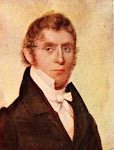
Lundy’s hard early life cost him most of his hearing, but he never forgot the shameful sound of the chains of slavery. And that sound motivated him to devote his life to the noble cause of abolition.

What an amazing man! His life saw hardship piled upon hardship, weakening his frail, under-sized figure; tragedy followed tragedy, culminating with his wife dying in childbirth while he was away on one of many fact-finding trips connected with his dream of universal emancipation. Yet, through it all, he never lost hope. He persevered, inspiring others to carry his singular candle, to follow in his solitary footsteps. To share his dream.

The abolition of slavery must have seemed an impossible goal in Lundy's time; despite all our modern resources, despite the great multitude of modern-day abolitionists, the goal still seems elusive, today. So: what can we do about it?

We can start as Benjamin Lundy started: we can start by hearing the chains of slavery.